Welcome to the Wyatt Exploration trip for 2010! Our theme is "Poland Between East and West." On May 3rd, 12 UM-Flint students, 3 faculty and I are headed for Krakow, ancient capital of the kingdom of Poland (before the Crown joined with the Grand Duchy of Lithuania and Warsaw seemed a more logical location). We'll be in Krakow May 5 to 17. We have a great itinerary planned and I really excited and curious to see how students enjoy Poland!

Tuesday, May 11, 2010

Balaton

We ate lunch on our ride back to Krakow from Auschwitz and the rest of the afternoon students had free.  It takes time to absorb the Auschwitz experience.  The deeper effect of the visit may only emerge much later at home when students show family and friends their pictures.
So for dinner this evening I chose a place that's tried and true, an older and still dependable restaurant on Grodzka street, just a block from the Rynek: the Hungarian restaurant Balaton---named for a lake in Hungary.  This restaurant was one of the better ones during the Communist decades, known for spicy food and endless bottles of Egri Bikaver, a Hungarian red.  It's still here, less elegant by today's standards; its metal-framed front windows and lucite door handle date back to the 1970s and the interior is the same, with red and green placemats.  But Balaton is friendly and not crowded (tourists go to newer, Italian style places). perhaps just happy to have survived and to have us. It's also early (you can see that it's light outside), so even as a large group of 15 we get great service. Chris (above, on the left) is delighted; his family is Hungarian.  Our waitress suggests some reliable dishes and one, of course, is goulash which comes to the table in its little chafing dish. Everything else is great too.

Auschwitz-Birkenau

We ride a mini-bus a couple of kilometers across a bridge to Auschwitz II-Birkenau.  This camp came into existence in fall of 1941, a monumental addition to Kl I and built by prisoner labor from Auschwitz I. The sick from Auschwitz I were transported to death here too. The  trains ended at the ramp, transports of human cargo were divided left and right---the vast majority of people going directly to eventually 4 huge gas chambers and crematoria. Birkenau was the major center for the extermination of the European Jews. The smaller number that survived a preliminary "selection" at the ramp went to slave labor, suffering extreme heat and cold crowded in the bunks of wooden barracks, dying from starvation, disease and work.
Today, on a May morning, the terrain is a deceptively quiet, low-laying plain (the Germans had cleared the villages and expelled the Polish population). Some students have difficulty grasping what went on here. I remind them to imagine this open space roiling with people---prisoners, guards, dogs moving at a fever pitch when each transport arrived, a shrieking and crying din, and then suddenly quiet until the next transport arrived. Day and night, hot summer and freezing winter. 
Plaques at the site of the crematoria memorialize those who perished here; in communist times, the language was "victims of fascism". Today the language recognizes that the majority of victims suffered because they were Jews, regardless of country of origin. 

Day 7: Auschwitz-Birkenau

Tuesday, May 11--- Auschwitz-Birkenau is a major point on our group's itinerary. Prof. Edyta Gawron and I had discussed when the students should go and we'd agreed: after students had learned about the long history of Jewish settlement in Poland and had walked the Kazimierz district in Krakow.  We enter the old camp, Kl I (Konzentrationslager I) or Auschwitz I, under the cynical motto of all the camps.
It's only about 9:30 am, but many groups are ahead of us---each with its own language guide. I'm impressed by each visit (this is my 4th) at the cadre of docents and how well trained they are. We step onto the poplar-lined paths that chart the visitors' route through the former World War I Polish army barracks the Nazis commandeered in spring of 1940, just months after invading Poland.  The solidity of the concrete columns of double electrical fencing show how hopeless was the idea of escape. 
The block house corridor walls are lined with the photos of inmates, male and female, young and old; these were the early prisoners whose passing utility as forced labor warranted camera and tattoo.  Their eyes look out at a camera as they were months before death, perhaps a year or more if they were stronger. Outside is the execution courtyard wall, below are solitary confinement, standing cells.  More blocks and corridors lead to rooms where we peer through glass at mounds of now gray-brown utensils, glasses, shoes, a small fraction of the tons of objects hoarded here for use in the Reich.  Cream and black prayer shawls in soft, fine wool hang immobile on rods---they would have covered swaying shoulders. 
We walk past past other landmarks---guard boxes, the kitchen, a gallows, the commendant's residence, a small, modest villa with flower beds, and finally reach the spot to the right of the old crematorium (later replaced by 4 crematoria when Birkenau was developed); here, after trial, Rudolf Franz Hoess was hanged in 1947.

Monday, May 10, 2010

Day 6: Auditorium Maximum of Jagiellonian University

Monday, May 10---Rain all day, at times just pouring, and our entire group needs to get down Krupnicza street, several long blocks from the Rynek, to a new Jagiellonian University building called "Auditorium maximum."  Since I am giving the lecture, we've decided to give up our umbrellas and get cabs at Atrium, our hotel.  The reception desk staff is wonderful; a couple of phone calls and then three mini-van cabs does it!
This new (opened in 2005) building is really part of a complex of buildings that includes a 1000 seat auditorium and was built together with European Union funds.  It's state of the art.  Anyway, this was my opportunity to "give back" to Jagiellonian University's Center for European Studies by giving a lecture about the writing of Henryk Grynberg.  Some Center Students came so this was a chance for our UM-Flint students to talk to the masters' level students studying here in Krakow.  And two of our students, Chris and Michelle, want to come back here to study! Here's the Center's website http://www.ces.uj.edu.pl/ou

Sunday, May 9, 2010

Sunday Dinner at Del papa

Here we all are at Del papa---ready to choose our first courses and second courses and our wine! We learned that "karafka" means a half carafe (not everyone drinks wine).  Conversing with our servers, asking questions, discussing the details of food is all part of the evening.  Everything is cooked to order so dining is leisurely (a new experience for some!) but the results are well worth waiting for.  Here's a sample---

More on Day 5 --- Sunday in Krakow

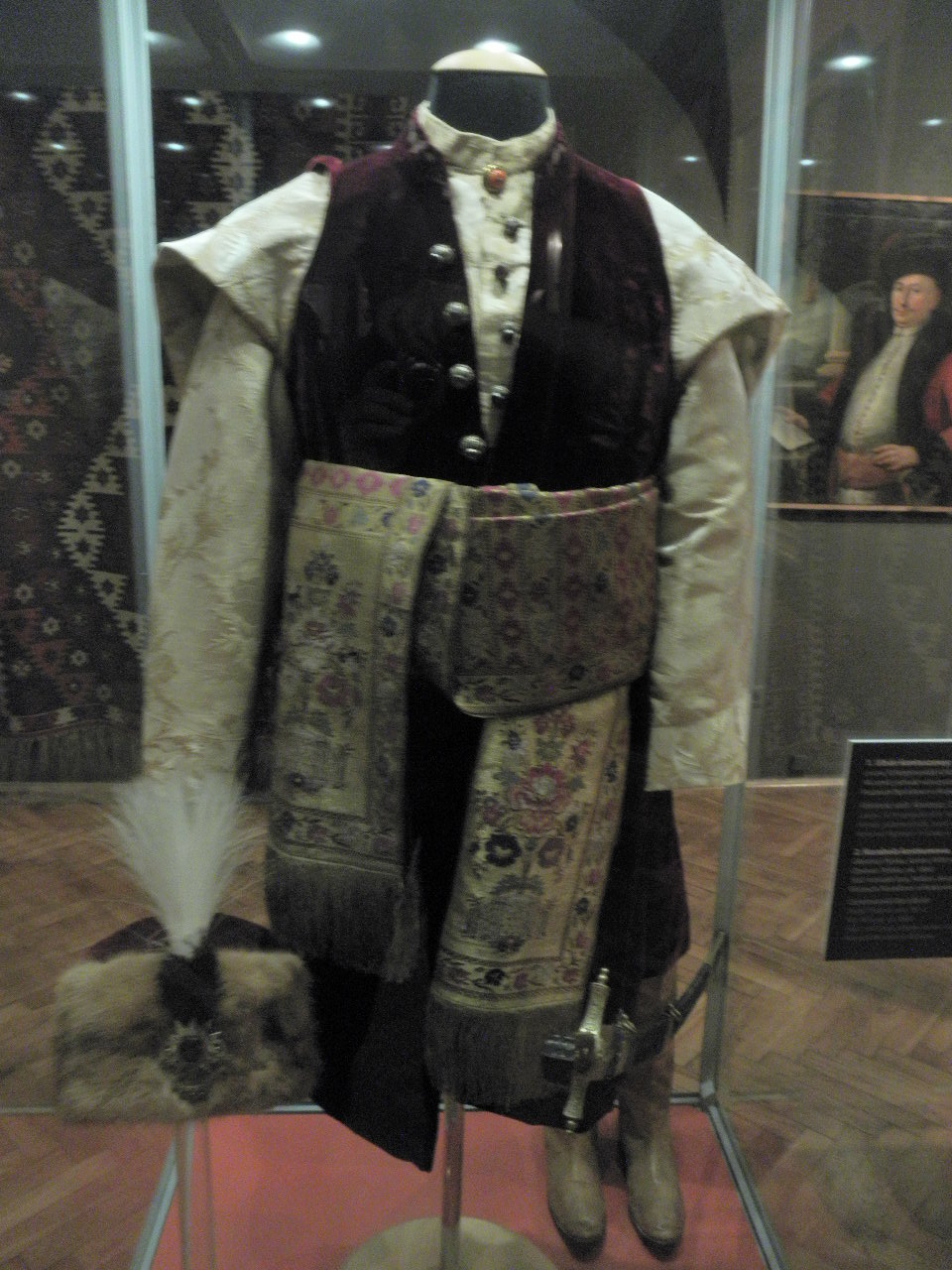
Well, today we're doing some typically Sunday things in Krakow: go out for a stroll, go to a museum, and have a lovely evening meal. Alas, it's been mostly drizzling and not a great day for the usual Sunday stroll (our sunniest day so far was yesterday while we were deep in the mind in Wieliczka!).  So after we visited the Wawel Cathedral we went back down into town to the Wyspianski museum in the Szolayski house which is a part of the National Museum in Krakow.  There's a great special exhibit for May:  "Sarmatism: A Dream of Power." Sarmatism defines the culture and mindset of the 17th century Polish gentry---former knights now become landowners.  
After their winged cavalry defeated the Turks at Vienna in 1683, these noblemen promptly turned around and adopted numerous Turkish elements as we see in this display of portraits, clothing, weapons.  Richly emboidered silk sashes, gold buttons, soft boots all in Turkish style---incredible wealth and display of swashbuckling Sapiehas, Rzewuskis, Tarnowskis, Czarneckis and Sanguszkos. 

Some of us took a break for tea and cake at the cafe Jama Michalika on Florianska St., a Krakow landmark from the turn of the 20th century with its cabaret, The Green Balloon (Zielony balonik).  Always full of tourist visitors, the service isn't great but the Young Poland ("Mloda Polska") atmosphere/decor is historic:  deep green and mahogany furnishings in Secessionist designs.    


For dinner we went to "Del papa" on sw. Tomasza or St. Thomas street alongside Plac Szczepanski.  Del papa is one of the quieter Italian restaurants, fewer tourists come here than the more well-known Miod Malina or Pod Aniolami. Its quality has helped it survive for several years. It's a nice spot late in the evening for just a drink too. Good menu with beautiful presentation. We have a long banquet table; our group is making some progress with dining skills: learning how to order, ask questions, discuss the history of foods.  Why is the Polish-Italian connection so natural and enduring?  Meals are a surprisingly important component of this Polish exploration.

Day 5: Wawel Cathedral

The Cathedral of Sts. Stanislaus and Wenceslaus, on the Wawel hill, is the place where poets and kings and bishops are buried. The Cathedral dates from the year 1000 when Krakow became a bishopic.  All of Polish history is somehow reflected here.  Barbara leads us up the steps beneath the great mammoth bone, and then we enter the main nave of the Cathedral with the huge silver sarcophagus of St. Stanislaus under a canopy directly ahead. On the right and left are sarcophagi of King Ladislaus Jagiellon and Ladislaus of Varna.  Tapestries  hang from the arches.  It's the "mother of churches" in Poland and the coronation cathedral, but the church is not that large.  We make our way around beginning at the left, looking at the chapels that line the side naves. We see Queen Jadwiga's altar, the Sigismund chapel, the white marble sarcophagus of Queen Jadwiga, and several dozen other chapels and monuments.  Then most the group climbs to the top of the bell tower (touching the clapper of the bell named "Zygmunt" for good luck).  Then we go down through the crypts below: first, underneth a heavy iron door, the poets (Mickiewicz, Slowacki, and Norwid) and then the crypt of St. Leonard (the oldest part of the cathedral), and (after many other crypts), that of Marshal Jozef Pilsudski, and the urn with soil from Katyn. Pilsudski is important in Polish history and not to be dismissed as a dictator. From Lithuania, he appreciated Old Poland of many ethnicities including the Jews (who mourned deeply at his death). His notion of a multi-cultural Polish state that included Wilno (Vilnius) and Lwow (L'viv) had outlived its time.  After 1945, Poland was moved westward and the eastern borderlands had their fates entwined with the Soviet Union.